
Key takeaways
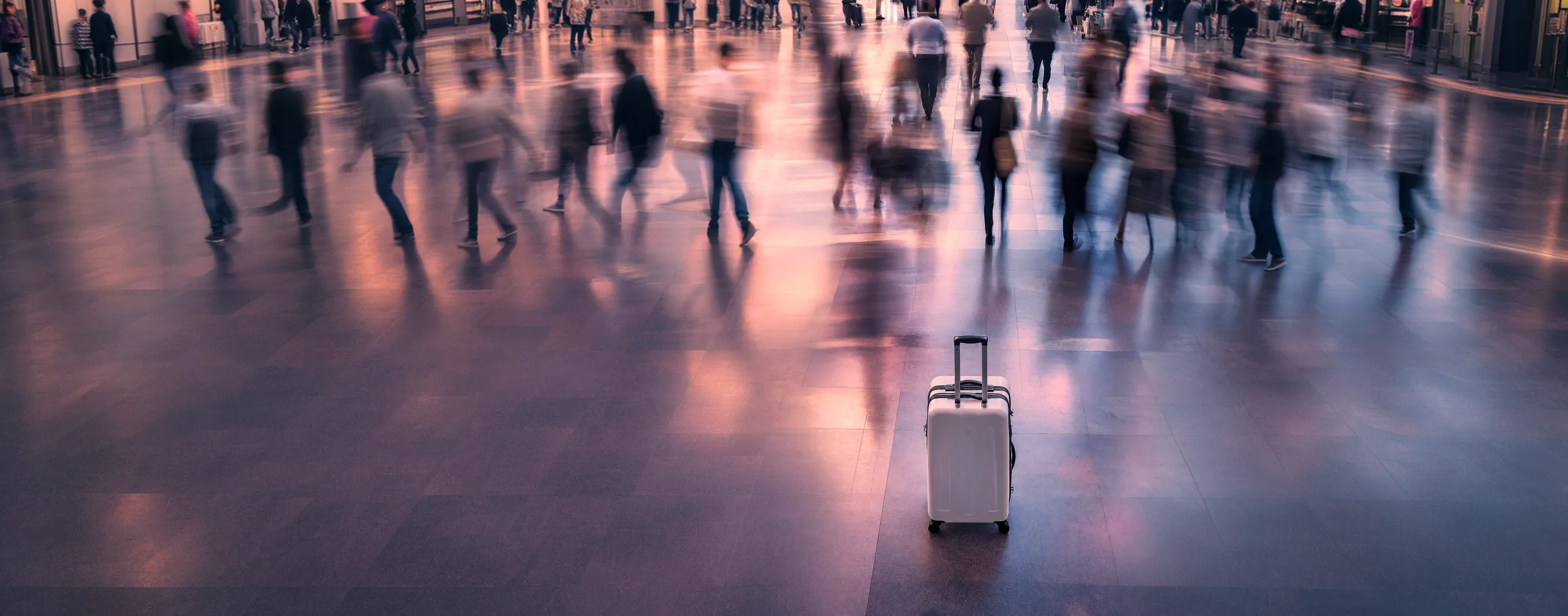
You land after ten hours in the air. Your connection leaves in 90 minutes. The screens show nothing useful. Then comes the question every long-haul traveller dreads. Is my suitcase going to the next plane or waiting on a carousel somewhere?
Get it wrong and you miss your flight standing at the wrong belt. Or you fly on while your bag stays behind. The good news is that the rules follow a clear logic once you know it. And if a late first flight turns a tight transfer into a missed connection, you may be owed compensation. Gyro checks that for you and handles the claim from start to finish.
Do you have to recheck baggage on connecting international flights?
Sometimes, and three factors decide it. The first is your booking. On one ticket, the airline tags your bag to your final airport and moves it between planes for you. On separate tickets, you collect it and check it in again, every time.
The second factor is where you first enter a country. Customs officers need to inspect your bag where you arrive so many countries make you reclaim it at that first airport. That rule applies even when the tag says your final city. The United States, Australia and China all work this way for most international-to-domestic connections.
The third factor is whether your airlines cooperate. Carriers with an interline or codeshare agreement can transfer bags between each other. Without one, your bag stops where the first airline's responsibility ends. Low-cost carriers often fall into this group, even within their own network.
Think of it like a parcel crossing a border. Within one courier's system, it moves on automatically. At customs, someone has to open the box. From our claims files, the costliest mistakes come from passengers who assume one rule covers every trip. A routing that worked through Frankfurt last summer can work very differently through Chicago this winter.
Will you need to recheck your bags?
Answer four quick questions to see what happens to your suitcase at your connection.
Based on airline and border agency guidance checked November 2026. Rules can differ by airline, terminal and route, so confirm with your airline before you fly.
Why do you have to recheck bags when connecting in the United States?
The US has no airside international transit. Every passenger landing from abroad enters the country at their first US airport. That applies even if you're flying straight on to Denver or Mexico City. US Customs and Border Protection (CBP) inspects travellers and their luggage at that first port of entry.
So the standard sequence at a US hub looks like this:
- Clear passport control.
- Collect your checked bags from the carousel, even if they're tagged through.
- Take them through customs and agriculture inspection.
- Drop them on the recheck belt just beyond the customs hall.
- Pass through TSA security again before heading to your gate.
That last step catches people out. Any liquids you bought in duty free must meet TSA's carry-on limits or go into your checked bag before you recheck it. Chicago O'Hare, for example, tells connecting passengers to pack liquids in checked luggage before re-entering security.
The full process often takes well over an hour at busy hubs. In our experience, transatlantic arrivals into New York, Chicago and Miami are where tight connections fall apart most often. A 40-minute delay in the air can easily become a missed flight on the ground.
Which US routes let you skip baggage recheck in 2026?
A growing but still short list. CBP and TSA now run four arrangements that remove the recheck for some passengers. They only work on specific routes and airlines. Check yours before you rely on one.
The newest is International Remote Baggage Screening (IRBS). X-ray images of your bag are taken at the departure airport abroad. CBP officers review them while you're still in the air. Cleared bags go straight to your connecting flight, unless CBP refers one for inspection. You still clear passport control and TSA security. You just skip the carousel.
The oldest option is CBP Preclearance. You complete US immigration and customs before you board abroad, then land as a domestic passenger. Your bags connect like any domestic transfer.
| Programme | What you skip at the US hub | Where it runs (November 2026) |
|---|---|---|
| CBP Preclearance | Immigration, customs and bag recheck | Dublin, Shannon, Abu Dhabi, Aruba, Bermuda, Nassau, Freeport and 9 Canadian airports including Toronto Pearson and Vancouver |
| One Stop Security | Bag recheck and TSA rescreening | London Heathrow to Atlanta (Delta) and Dallas Fort Worth (American) |
| International Remote Baggage Screening | Bag reclaim and recheck | Sydney to Los Angeles (American) and San Francisco (United); Seoul Incheon to Atlanta, Detroit, Minneapolis, Seattle and Los Angeles (Delta, Korean Air); Doha to New York JFK (Qatar Airways); Tokyo Haneda to Atlanta (Delta) |
| International-to-international transfer | Bag recheck when flying on abroad | Selected flights at Miami, Dallas Fort Worth, Houston Intercontinental and Guam |
Source: US Customs and Border Protection and TSA announcements, airline press releases, 2025 to 2026. Routes change often. Confirm with your airline before you travel.
These programmes are still pilots. Eligibility can depend on your exact flight. A bag that misses its inbound flight, or gets flagged for inspection, may still need collecting. Our advice: if your airline hasn't confirmed in writing that you can skip the recheck, plan as if you can't.
Do you have to collect your bags when connecting in Europe?
Usually not, on a single booking. Europe's big hubs, from Frankfurt to Madrid, transfer checked bags airside. You head for the flight connections signs, pass a security check and walk to your gate. Your suitcase reappears at your final airport.
The legal reason sits in EU customs law. Article 39 of Regulation (EU) 2015/2447 covers hold bags arriving from outside the EU and moved onto an intra-EU flight. Customs checks them at the last EU airport of your journey. Cabin bags, by contrast, are checked at your first EU airport. So on a New York to Rome trip via Amsterdam, you clear customs with your suitcase in Rome.
There are a few catches worth knowing:
- Passport control still applies. Arriving from outside Schengen and connecting to a Schengen flight, you clear immigration at your first Schengen airport.
- Security rescreening is common. Many EU hubs screen transfer passengers arriving from outside the EU. Duty-free liquids can be confiscated.
- The UK has its own rules. At Heathrow, most single-booking passengers connecting onward don't collect their bags. Some airlines still ask passengers flying on to a UK domestic flight to collect and recheck. Check your carrier's instructions.
From what we see in claims, missed connections in Europe rarely come down to baggage. They usually come from late inbound flights and long passport queues. That matters, because a late inbound flight is the airline's problem, not yours.
Did you know?
Under EU customs rules, a bag flown in from outside the EU and moved onto a flight within the EU is normally customs-checked at your final EU airport, not where you change planes. That's why you rarely see your suitcase during a Frankfurt or Amsterdam connection.
Which countries make you collect bags on an international-to-domestic connection?
Quite a few outside Europe. The pattern is consistent: if your connection is your first entry point, expect to see your bag. The table below shows the most common connecting countries.
| Connecting in | International to international | International to domestic |
|---|---|---|
| United States | Collect and recheck | Collect and recheck (route exceptions apply) |
| Canada | Varies by airport and airline | Varies by origin and airline |
| EU countries (e.g. Germany, France, Netherlands, Spain, Italy) | Checked through | Checked through |
| United Kingdom | Checked through | Varies by airline |
| Turkey | Checked through | Checked through |
| United Arab Emirates | Checked through | Collect and recheck |
| Australia | Checked through | Collect and recheck |
| Japan and South Korea | Checked through | Collect and recheck |
| China | Varies by airport and airline | Usually collect and recheck (some Beijing and Shanghai exceptions) |
| India | Collect and recheck | Collect and recheck |
Source: Singapore Airlines baggage transfer guidance, Heathrow, Air Canada, Virgin Australia and Asiana airport guides, checked November 2026. Rules assume a single booking and can differ by airline, terminal and connection time.
Australia shows how strict this can be. Virgin Australia tells every passenger arriving from abroad to collect their bags at the first Australian airport. You then clear customs and quarantine and drop them at a domestic transfer desk. Canada is the opposite of predictable. At Toronto Pearson, Air Canada lets passengers from listed origins skip the carousel, while everyone else must collect.
When a country sits in the "varies" column, ask at your first check-in desk. Then ask again at the transfer airport if signs say otherwise. We've handled cases where passengers followed the first agent's advice, flew on, and arrived without a suitcase.
Do you have to recheck bags on separate tickets or self-transfer bookings?
Almost always, yes. Two tickets mean two contracts. The first airline carries your bag to the end of its flight. That's it. You walk to the arrivals hall, collect it, check in again and pass security once more.
This has knock-on effects many travellers miss:
- You need the right to enter the country. Collecting a bag usually means passing immigration. You may need a visa or travel authorisation even for a short stopover.
- Minimum connection times don't protect you. Airlines only guarantee connections they sell together. On separate tickets, a late first flight is your risk.
- Baggage agreements can rescue you. Some airlines will tag bags through between partners, even on separate tickets. That depends on their codeshare and interline deals, not on any legal right.
Booking sites often stitch budget flights together and call it a "self-transfer". That label is your warning to collect your bags. Leave hours, not minutes, between flights. We regularly see passengers on self-transfer trips lose the second ticket entirely because a baggage carousel ran slow.
How can you tell if your bags are checked through to your final destination?
Look at the bag tag receipt the agent gives you at check-in. It shows a three-letter airport code. If that code is your final airport, the bag is tagged through. If it shows your connection airport, you'll be collecting it there.
A few other checks help:
- Boarding passes. Getting a boarding pass for every flight at your first check-in usually means a through booking.
- Ask directly. Say "Do I collect this in Chicago, or at my final destination?" Agents answer that question far more reliably than a vague one.
- Airline app tracking. Most major airlines now show your bag's route and each scan along the way.
- Signs on arrival. At the connection airport, signs for "connecting passengers" or "baggage recheck" will tell you what to do.
Remember that a tag through to your final city doesn't override customs. Arriving in the US, you still collect a bag tagged to Denver at your first US airport. Snap a photo of your tag receipts too. If a bag goes missing during a transfer, they're the first thing the airline asks for.
Does EC 261 cover a missed connection caused by rechecking your bags?
It can, if your connections sit on a single booking and the first flight arrived late. In Air France v Folkerts (C-11/11), the Court of Justice of the EU ruled that delay is measured at your final destination. So a 90-minute late first flight that causes a missed connection can still lead to compensation. What counts is reaching your final airport 3 or more hours late.
EC 261 applies to flights departing an EU airport on any airline. It also covers flights arriving in the EU on an EU carrier. The CJEU also confirmed in Wegener (C-537/17) that a single booking from the EU stays covered even when you connect outside Europe. So a Lisbon to Boston to Chicago booking can be covered, US recheck and all.
Here's where the baggage recheck becomes important. Airlines often blame a missed US connection on slow customs or the recheck queue. But say your inbound flight landed late and cut your transfer below the minimum connection time. Then the misconnection usually belongs to the airline. Our guide to what happens when you miss a connecting flight covers rebooking and refunds in detail.
The amounts depend on distance:
- €250 for flights up to 1,500 km
- €400 for flights between 1,500 and 3,500 km, and intra-EU flights over 1,500 km
- €600 for flights over 3,500 km, which can be halved if you arrive between 3 and 4 hours late
UK261 mirrors these at £220, £350 and £520. If your first flight was on time and you simply ran out of time at the carousel, compensation is unlikely. On a single booking, though, the airline should still rebook you at no extra cost. We see this argument often. Flight data usually settles it quickly in the passenger's favour.
What can you claim if your bag is lost or delayed during a baggage recheck?
Transfers are where bags most often go astray. Rechecking adds another handover. On international trips, the Montreal Convention makes airlines liable for delayed, damaged or lost baggage. The limit has stood at 1,519 Special Drawing Rights per passenger since December 2024, roughly €1,850 at current rates.
If your bag doesn't appear at your final airport, act before you leave the baggage hall:
- Report it at the airline's baggage desk and get a written file reference.
- Keep receipts for essentials you buy while you wait, such as toiletries and clothes.
- Send a written complaint within 21 days of the bag's delivery for a delay, or within 7 days for damage.
Our guide to delayed baggage compensation explains what airlines typically pay and how to push back on lowball offers. One caution from our claims work. If you skipped a required recheck at your first US airport, the airline may blame you for the delay.
How much connection time do you need if you have to recheck bags?
More than the airline's minimum, ideally. Minimum connection times are the shortest transfer an airline will sell, not a comfortable one. They also assume everything runs to schedule, which international arrivals often don't.
When a recheck is involved, build in a buffer:
- US entry hubs. For your first US airport, we suggest at least two hours, and more at peak times.
- Global Entry and Mobile Passport Control. Both can shorten passport queues. Neither moves your bag faster.
- Terminal changes. Factor in trains or buses between terminals after you recheck.
- Late evening arrivals. Several long-haul flights landing together can stretch customs queues for an hour or more.
Tight connections aren't a disaster on a single booking, because the airline must rebook you. They just cost you time. On separate tickets, a short connection risks the whole onward trip.
What should you remember about rechecking bags on international connections?
The rule of thumb is simple. One booking through Europe or the Gulf usually means your bag flies straight through. One booking into the US, Australia or China usually means collecting and rechecking at your first airport. Separate tickets mean rechecking almost everywhere.
The exceptions are growing. Remote screening now covers routes from Sydney, Seoul, Doha and Tokyo. Preclearance at Dublin, Shannon and Canadian airports removes US customs from the equation altogether. Still, these remain route-specific. Never assume your flight qualifies.
Most importantly, a recheck queue doesn't cancel your passenger rights. If a late first flight cost you a connection on one booking, you could be owed up to €600 or £520. Check your eligibility with Gyro in under a minute. Or connect your inbox to Autopilot and let us scan three years of past flights for money you're still owed.
Missed your connection after a late arrival?
If a delayed first flight made you miss your connection and you reached your final destination 3+ hours late, you may be owed €250 to €600 under EC 261 or £220 to £520 under UK261. Gyro checks your eligibility for free. You keep 100% of whatever the airline pays.
- Free eligibility check in 60 seconds, connecting flights included
- You keep 100% of the compensation, no percentage cut
- Autopilot scans your inbox for eligible flights from the last 3 years
Frequently asked questions
Do you have to recheck bags when flying from Europe to the US with a connection?
Yes, on most routes you collect and recheck your bags at your first US airport.
- CBP requires inspection at your first port of entry, even on a single booking
- Flights from Dublin and Shannon use US Preclearance. You clear customs before departure and skip the recheck
- Delta's Heathrow to Atlanta and American's Heathrow to Dallas Fort Worth flights run under One Stop Security
- Confirm with your airline, because eligibility can depend on the specific flight
Further reading: Can you leave the airport during a layover? Rules by country
Do you have to recheck bags if you connect in the US to another international flight?
Usually yes, because the US has no airside international transit.
- You enter the US, collect your bags, clear customs and recheck them
- A few international-to-international transfer arrangements exist at Miami, Dallas Fort Worth, Houston and Guam
- These cover selected airlines and flights only. Ask before you book
- You also need a visa or ESTA, even if you never leave the airport
Do you have to go through security again after rechecking your bags?
In the US, almost always yes.
- After the recheck belt, you pass a TSA checkpoint before reaching your gate
- Duty-free liquids above carry-on limits must go into your checked bag before you recheck it
- One Stop Security on selected Heathrow routes is currently the main exception
- Many European hubs also rescreen passengers arriving from outside the EU
Further reading: What items are not allowed in checked luggage? The full 2026 list
What happens if you forget to collect your bags at your first US airport?
Your bag will probably not reach your final destination on time.
- Uncollected bags stay at the arrival airport until they clear customs
- Report the problem at your final airport's baggage desk straight away
- The airline may argue you caused the delay, which can weaken a compensation claim
- Keep your bag tag receipt, as it speeds up tracing
Further reading: Montreal Convention: what airlines owe you for delays & lost bags
Can you claim compensation if the baggage recheck made you miss your connection?
Only if a late inbound flight caused it and your trip was on a single booking.
- EC 261 and UK261 measure delay at your final destination, following the Folkerts ruling
- Arriving 3+ hours late can mean €250 to €600, or £220 to £520 under UK261
- If your first flight was on time and the queue alone made you late, compensation is unlikely
- The airline should still rebook you free of charge on a single booking
Further reading: How to claim flight compensation: a step-by-step guide for 2026